

If you want a fast answer, CamelCamelCamel and Keepa are the most reliable free price history checker tools for Amazon, while PayPal Honey and Google Shopping work best for everyday multi-store drop alerts. For e-commerce brands tracking thousands of competitor SKUs across multiple storefronts, commercial platforms like Prisync and Price2Spy—or a custom collection pipeline—deliver the automated depth that browser extensions cannot match.
This guide explains how historical price tracking works under the hood, compares the top free shopper extensions and commercial retail monitors side by side, and walks through how brands can verify regional pricing differences and scale custom price collection cleanly.
What Is a Price History Checker and How Does It Work?
A price history checker is a browser extension, web app, or analytics platform that records a product’s selling price over time and displays it as an interactive timeline chart. Instead of showing only today’s listing price, it lets you inspect how much an item cost weeks, months, or years ago.
Understanding the difference between live comparison tools and historical trackers makes it easier to spot genuine value:
- Real-Time Comparison vs. Historical Context: Standard shopping comparison engines tell you which store offers the lowest price right now. A historical price tracker adds time-series context, revealing whether a “50% off” holiday badge is a true seasonal low or the result of an artificial price hike days before a sale.
- Key Metrics Tracked: Most dedicated checkers log base retail prices, third-party marketplace offers, shipping thresholds, and stock availability timestamps so buyers and analysts can see recurring discount cycles.
- How Data Gets Collected: Behind every price chart is an automated schedule that periodically reads public product pages, extracts the visible price and seller metadata, and appends each snapshot to a timestamped database. Consumer tools share that public database through free extensions, while commercial trackers run private schedules tailored to a brand’s specific competitor list.
Which Price History Checker Fits Your Needs Best?
Different price trackers are built for very different goals—some focus exclusively on Amazon charts, while others monitor thousands of competing retail catalogs daily. Use the table below to match each tool’s coverage and pricing model to your workflow before diving into individual features.
| Tool | Primary Coverage | Pricing Model | Historical Depth |
| CamelCamelCamel | Amazon marketplaces | Free | Multi-year Amazon charts |
| Keepa | Amazon marketplaces | Free tier + paid plans | Deepest Amazon & Buy Box history |
| PayPal Honey | Thousands of retail sites | Free | Short-to-medium drop trends |
| Google Shopping | Indexed online retailers | Free (Google account) | Recent price range insights |
| Prisync | Multi-site e-commerce catalogs | Paid SaaS plans | Automated daily competitor logs |
| Price2Spy | Global e-commerce (40+ countries) | Paid / quote-based plans | Long-term multi-country analytics |
| Visualping | Any public webpage URL | Free tier + paid plans | Visual & text change snapshots |
Top Free Price History Checkers for Online Shoppers
For everyday buyers, installing one or two lightweight browser tools is usually enough to verify whether a sale price is genuinely low. Below are the four most reliable free options and where each one works best.
- CamelCamelCamel — Simple Free Amazon Price History
CamelCamelCamel is a dedicated Amazon price history checker that tracks millions of listings across major Amazon locales (including the US, UK, Canada, Germany, and Australia) without requiring an account just to view charts.
- Key advantages: Displays clean historical graphs comparing Amazon direct prices, third-party new offers, and third-party used offers; includes email alerts when an item hits your target price and a browser add-on (The Camelizer) that embeds charts directly on product pages.
- Limitations: Works exclusively on Amazon domains and will not track prices on Walmart, Target, or independent brand stores.
- Best for: Everyday Amazon shoppers who want straightforward price charts and email drop alerts at zero cost.
- Official website:
https://camelcamelcamel.com
- Keepa — Detailed Amazon Price and Buy Box Charts
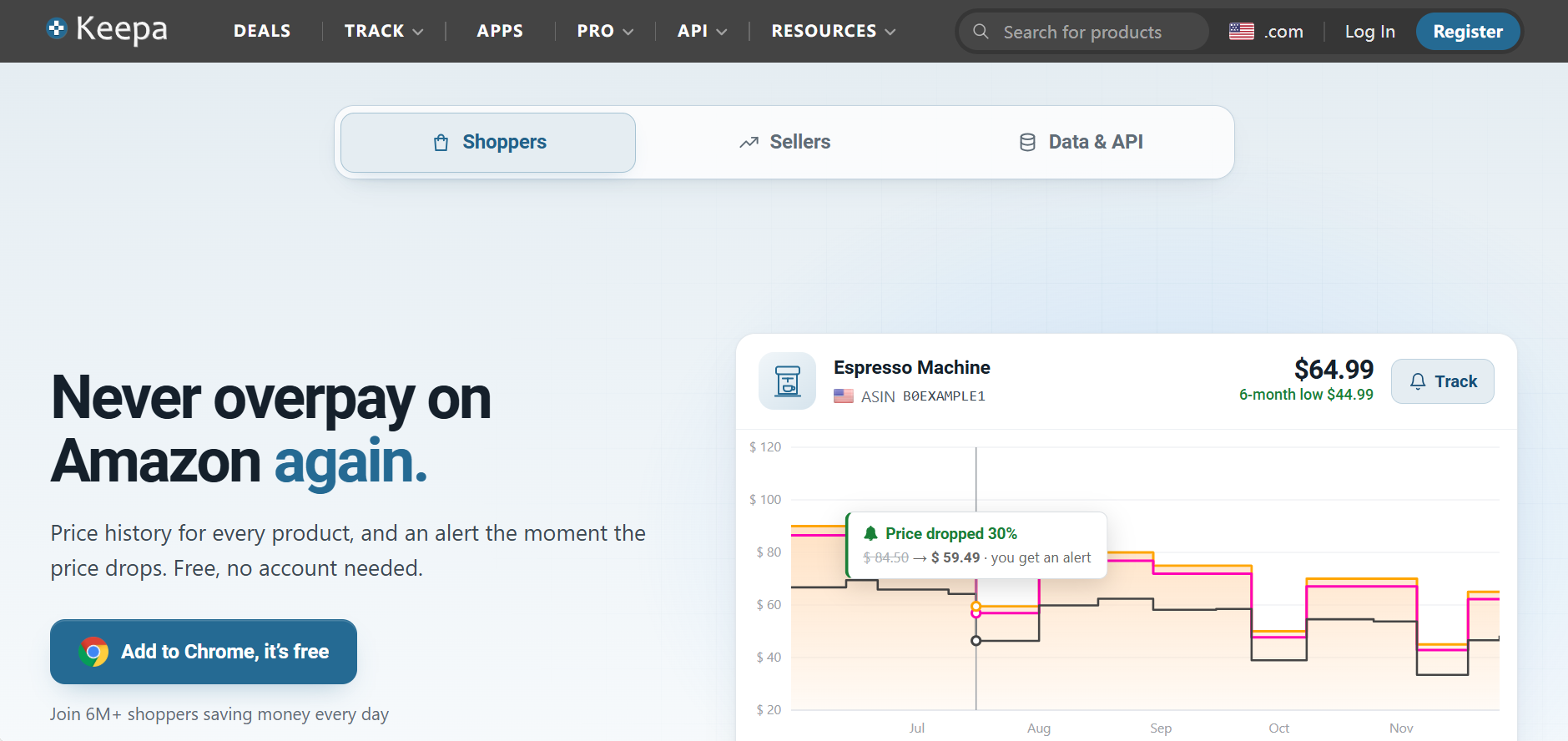
Keepa is the most data-rich historical tracker for Amazon, monitoring billions of products across international Amazon marketplaces through its web portal, mobile app, and browser extension.
- Key advantages: Injects interactive price history graphs directly beneath Amazon product listings, tracking Amazon retail prices, marketplace offers, lightning deals, and back-in-stock events with alert delivery via email, browser push, or Telegram.
- Limitations: While basic price history charts and alerts are free, advanced seller metrics—such as Buy Box ownership statistics, sales rank history, and API access—require a paid monthly subscription.
- Best for: Detail-oriented Amazon buyers and third-party sellers who need granular historical context before buying or sourcing.
- Official website:
https://keepa.com
- PayPal Honey — Multi-Retailer Droplist and Alerts

Owned by PayPal, Honey combines automated checkout coupon testing with a built-in Droplist feature that monitors price drops across tens of thousands of online stores.
- Key advantages: Lets you save items from major retailers (such as Target, Best Buy, Macy’s, and Nike) to a single watchlist and notifies you via email when the price falls by your chosen percentage threshold.
- Limitations: Historical price graphs are simpler and cover shorter timeframes than Amazon-focused tools like Keepa, and Droplist tracking is not supported on every niche merchant site.
- Best for: Multi-store shoppers who want basic price-drop alerts alongside automatic coupon discovery in one extension.
- Official website:
https://www.joinhoney.com
- Google Shopping — Built-In Cross-Store Price Insights
Google Shopping integrates price comparison and basic historical context directly into Google Search results and the Google app for signed-in users.
- Key advantages: Requires zero browser extensions to install; supported product cards display a Price insights bar showing whether today’s price is low, typical, or high compared to recent weeks, plus a one-tap Track price toggle for email and mobile notifications.
- Limitations: Price insight cards and alert toggles are only available on eligible product listings in supported regions, and Google does not guarantee fixed hourly check intervals or multi-year downloadable charts.
- Best for: Mobile and desktop shoppers who want fast cross-retailer price context without adding third-party extensions.
- Official website:
https://shopping.google.com
Best Commercial Price History Trackers for E-Commerce Teams
Browser plugins work well for checking a handful of personal wishlist items, but e-commerce brands and retail analysts need automated SKU matching, scheduled refreshes, and exportable historical logs across competing stores. Below are three established commercial platforms designed for team workflows.
- Prisync — Automated Competitor Price and Stock Tracking
Prisync is a cloud-based competitor price tracking and dynamic pricing platform built for online retailers and brands that need continuous visibility across competing storefronts.
- Key advantages: Automatically matches identical products across competitor websites using URLs, barcodes, or SKUs; records daily historical price and stock availability timelines; supports automated repricing rules and scheduled email/CSV reports.
- Limitations: Pricing scales with the number of tracked URLs and refresh frequency, making it less cost-effective if you only need occasional spot checks on a few products.
- Official website:
https://prisync.com
- Price2Spy — Multi-Country MAP and Historical Analytics
Price2Spy is an enterprise-ready price monitoring and analytics suite used by brands, distributors, and retailers operating across international markets.
- Key advantages: Supports historical price tracking across more than 40 countries and multiple currencies; tracks Minimum Advertised Price (MAP) violations, promotional shifts, and assortment changes with customizable dashboards and API exports.
- Limitations: Initial catalog onboarding and complex matching rules take longer to configure than plug-and-play extensions, and high-volume plans require custom quotes.
- Official website:
https://www.price2spy.com
- Visualping — Flexible Page-Change and Offer Alerts
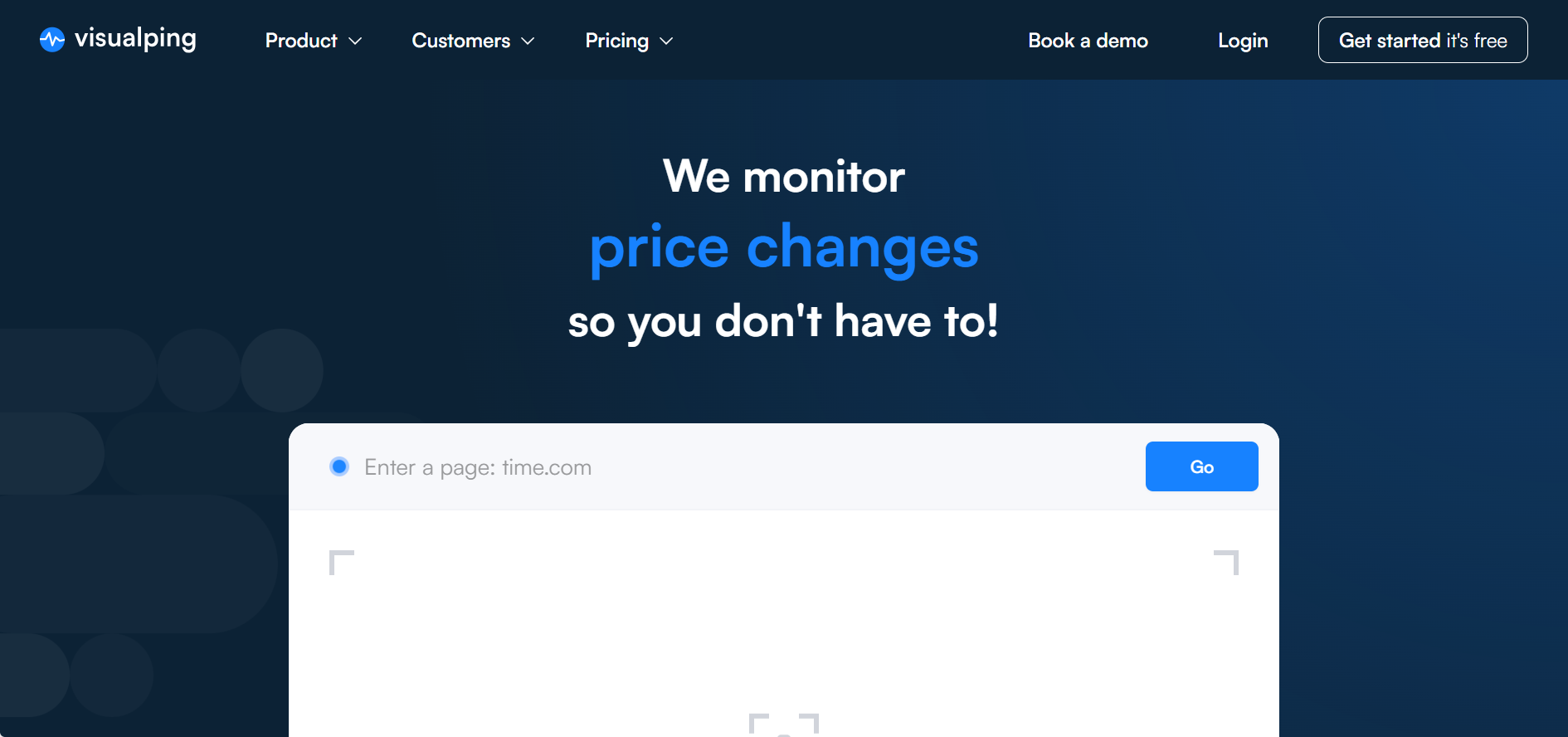
Visualping is a general-purpose web change monitoring tool that watches specific page areas for visual, text, or HTML updates rather than relying solely on structured e-commerce feeds.
- Key advantages: Monitors virtually any public webpage—including niche B2B portals, clearance pages, or regional distributors unsupported by standard shopping trackers—and highlights exact price edits with timestamped visual screenshots.
- Limitations: Designed for URL-by-URL page change alerts rather than automated multi-retailer catalog matching or bulk margin analytics.
- Official website:
https://visualping.io
Power scalable growth for every cross-border business scenario with IPFLY’s reliable global proxy network
Why Does Historical Price Data Break Across Regions and Scale?
Once a retail team moves beyond manual browser checks to automated multi-region tracking, off-the-shelf plugins and single-server scripts often produce incomplete or misleading historical charts. Two technical bottlenecks explain most of those gaps:
- Geo-Targeted Pricing and Regional Storefronts: Major retailers and marketplaces routinely adjust displayed prices, shipping fees, currency formatting, and stock status based on a visitor’s country, region, or postal code. If your monitoring request originates from a single data-center server in one country, your historical chart reflects only that server’s local view—missing regional promotions or localized competitor undercutting. Comparing residential proxy types shows why testing from real regional networks is essential for verifying accurate local prices.
- Rate Limits and Stale Cached Pages: Polling thousands of product pages every hour from a single IP address quickly triggers HTTP
429rate limits, CAPTCHA walls, or403blocks. Even worse, some edge caches serve outdated static price snapshots to flagged data-center ranges, silently corrupting your historical timeline. Applying sound data scraping basics—such as distributed request routing and clean session management—keeps collected price logs accurate over time.
How to Build a Custom Price History Checker with IPFLY?
When commercial SaaS trackers do not cover regional storefronts, niche distributor portals, or custom refresh schedules, building a lightweight internal price history checker gives your team full control over which SKUs get sampled and how often. Pairing your collection script with reliable network routing prevents regional price distortion and single-IP rate limits.
Choosing the Right IPFLY Proxy for Price Collection
To match different target storefronts and polling frequencies, IPFLY offers three core proxy lines supporting both HTTP(S) and SOCKS5 protocols:
- IPFLY Residential Proxies: Route requests through a global pool of real residential IP addresses with country- and city-level targeting. You can rotate to a fresh IP on each request or hold one IP for a short sticky-session window, billed strictly by traffic volume—ideal for checking localized pricing across multiple countries or polling large retail catalogs without single-IP throttling.
- IPFLY ISP Proxies: Provide dedicated, non-rotating IP addresses hosted on real Internet Service Provider (ISP) infrastructure, billed per IP and duration. They work best when your pipeline monitors a fixed regional storefront over weeks and needs consistent session continuity.
- IPFLY Datacenter Proxies: Deliver dedicated, static IP addresses hosted on high-speed server infrastructure, billed per IP and duration. They prioritize high throughput and predictable per-IP cost for public APIs or smaller merchant sites, though major marketplaces with strict firewall rules may still scrutinize data-center ranges more closely than residential connections.
Evaluating cross-border ecommerce proxies alongside the trade-offs of residential versus datacenter routing makes it straightforward to match each target domain with the right connection tier.
Simple Workflow for Accurate, Compliant Price Tracking
You do not need an overly complex architecture to build an internal historical price log:
- Define Your Target URLs and Fields: Maintain a clean list of product URLs and extract only public fields—such as base price, sale price, currency, stock status, and seller name—alongside an ISO timestamp.
- Select the Right Parser or Headless Browser: Static HTML product pages can be parsed with lightweight HTTP requests, while JavaScript-heavy storefronts render more reliably with modern scraping tools configured to route through your IPFLY endpoint.
- Store Snapshots and Follow Responsible Boundaries: Append each run to a CSV file or time-series database so you can chart historical lows and alert thresholds. Always limit collection to publicly visible pricing data, add polite delays between requests, avoid login-restricted or personal account pages, and respect each site’s
robots.txtrules and terms of service.
Frequently Asked Questions About Price History Checkers
What is the best free price history checker for Amazon?
CamelCamelCamel and Keepa offer the most reliable free Amazon price history charts, third-party offer tracking, and automated price-drop alerts.
Can a single price history checker track every online store?
No single consumer extension covers every retailer, so shoppers often combine tools like Keepa and PayPal Honey while brands rely on commercial monitors or custom scripts.
Why do product prices differ depending on my location?
Online retailers frequently adjust displayed prices, shipping fees, taxes, and promotions based on the visitor’s country, currency, or regional warehouse availability.
How often should e-commerce teams check competitor price history?
Most retail teams sample fast-moving SKUs every few hours to once daily depending on catalog size, promotional intensity, and category price volatility.
Is it legal to collect public product prices for historical tracking?
Gathering publicly visible product prices is generally permitted when you avoid personal or gated data, keep request rates polite, and respect website terms of service.
Conclusion
Choosing the right price history checker depends on whether you are verifying a single personal purchase or tracking thousands of competing listings across international markets. Everyday shoppers can spot real discounts quickly with free tools like CamelCamelCamel, Keepa, PayPal Honey, and Google Shopping, while e-commerce teams can scale multi-region historical tracking cleanly through commercial platforms or custom pipelines powered by IPFLY’s residential, ISP, and datacenter proxy infrastructure.